The Best Satinwood Paints For Interior Wood And Metal
Mid-sheen trim paints for skirting and door frames as well as radiator pipes.

Our quick verdict
Our pick of the best satinwood paint is the Dulux Quick Dry, a water-based satinwood that dries fast enough to get both coats on a room's doors, frames and skirting in a single day, and it goes further per litre than most. If you can leave the woodwork overnight, the Dulux Once White Satinwood Paint is designed to finish in one thick coat and costs less.
DIY Works is reader supported. If you buy through our links we may earn a commission, which never changes what we recommend. How we make money.
Our Picks At A Glance
- Check price of Dulux Quick Dry
- Check price of Johnstone’s Interior Wood & Metal
- Check price of Dulux Once White Satinwood Paint
- Check price of Crown Quick Dry Satin Paint
Best All-Rounder
Crown Quick Dry Satin PaintHard-wearing wipeable woodwork in busy hallways and kids' rooms
- Check price of Ronseal 2-in-1 Satinwood Paint
Best Non-Yellowing
Ronseal 2-in-1 Satinwood PaintBare or worn interior wood where you want to skip the primer
- Check price of Leyland Oil Based Satinwood Paint
Best Value Runner-Up
Leyland Oil Based Satinwood PaintLarge areas of woodwork on a tight budget where smell isn't a concern
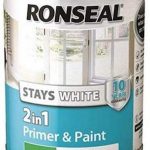
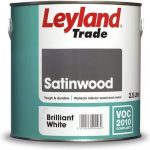
Water or oil is the decision that shapes everything else. Water-based tins dry fast with little smell and keep white woodwork white, while an oil-based satinwood lays down smoother but needs a full day to dry, smells strongly and drifts towards cream.
Coverage is the other figure to compare, as the tins here range from 6.5 to 20 square metres per litre, and that gap changes how many you'll need for a whole house. The list covers both bases, from a one-coat white to a primer-and-paint for bare wood.
How We Tested These Satinwood Paints
Most of our testing took place during a renovation of our own house, with more touch-up work carried out in the Airbnbs and rentals we look after. The paints went on skirting boards, architraves and door frames, and we used them on metal too, including radiator pipes running along the walls.
Dulux Once Satinwood was the one we liked most, and it worked really well on skirting. The Short below shows how easily it brushed out along the board.
Skirting Board Paint: Satin, Gloss, Eggshell or Stained? We've Tested Them All To Find The Best!
We keep buying newer satinwoods as brands update their ranges, and the photos below show some of the tins that have been through our hands. Each paint was judged on:
- Coverage: how far the tin went and how many coats the woodwork needed
- Application: whether it brushed out smoothly or dragged
- Finish: how even the sheen looked once dry
- Yellowing: how well the paint is made to resist it
- Drying time: how soon we could recoat and use the room
- Colours: the choice beyond brilliant white
- Value: how far your money goes per litre


Where we haven't used a paint long enough to judge how it ages, we've relied on the manufacturer's figures for coverage and drying, and said so.
The Best Satinwood Paints We Recommend
The list covers water-based satinwoods and an oil-based option from Leyland. All six are for interior woodwork.
Best Overall
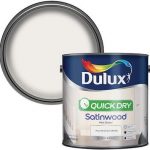
Dulux Quick Dry

Best for: Doors, frames and skirting where you want two coats done in a day
Check Price On AmazonDulux Quick Dry Satinwood is a premium water-based trim paint that's touch dry in an hour. Dulux recommends two coats with a brush and at least 6 hours between them, so you can finish a room's woodwork in a single day with an early start. The tin in our photo is Natural Calico, which shows it's not just a white paint.
It's self-undercoating, low in odour and goes onto both wood and metal, so the same tin covers doors, frames and radiator pipes. The non-drip formula stays where you put it on vertical surfaces, and Dulux says it stays white with a non-yellowing finish. Coverage is up to 16 square metres per litre, better than most satinwoods here, which takes some of the sting out of it being the most expensive per litre in this roundup.
What we like
- Touch dry in 1 hour
- Up to 16 square metres per litre
- Self-undercoating with low odour
- Non-yellowing according to Dulux
- Non-drip on vertical surfaces
What to know
- Most expensive per litre in this roundup
- Needs two coats with 6 hours between them
Our verdict
For most interior woodwork, Dulux Quick Dry Satinwood is the paint that lets you start after breakfast and have the second coat on by evening, and Dulux makes the white to stay white. It's the dearest per litre here, though it also covers more than most. Anyone happy to leave the paint overnight can save money and a coat with Dulux Once Satinwood.
Best Value
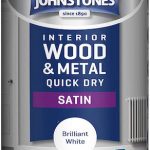
Johnstone’s Interior Wood & Metal

Best for: Whole-house woodwork on a budget with a colour choice
Check Price On AmazonJohnstone's Quick Dry Satin is the closest rival to Dulux and costs less. It's an affordable water-based paint in ten colours, which makes it a good option if you'd like painted doors or frames in something other than white.
Johnstone's recommends applying it liberally by brush or roller and leaving 3 to 4 hours before the second coat. It's touch dry in 1 to 2 hours, self-undercoating and low in odour, with a non-yellowing finish. Coverage is 12 square metres per litre, and tins come in 0.75, 1.25 and 2.5 litres, so you can buy exactly what the job needs. On our woodwork it needed two coats for the best finish.
What we like
- Choice of ten colours
- Touch dry in 1 to 2 hours
- Self-undercoating
- Water based and low in odour
- 0.75, 1.25 and 2.5 litre tins
What to know
- Needed two coats on our woodwork
- 12 square metres per litre is less than Dulux Quick Dry
Our verdict
A whole house of woodwork on a sensible budget is where Johnstone's makes sense, and the ten colours help if white isn't the plan. Self-undercoating and low odour make it simple to live with during the job. Expect two coats, as ours needed them, and pick from the three tin sizes so you're not left with a half-full 2.5 litre tin.
Best One Coat
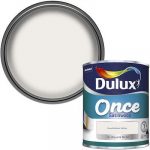
Dulux Once White Satinwood Paint

Best for: Refreshing white woodwork with one thick coat
Check Price On AmazonAs the name says, Dulux Once is designed to finish in a single coat. Dulux recommends laying it on thickly and evenly, and that's what we did on skirting during our renovation. The result was excellent, as the Short in our testing section shows.
It needs no undercoat and Dulux says it won't yellow. Against Dulux Quick Dry, it costs less and saves a coat, but it takes up to 16 hours to dry fully and covers 12 square metres per litre instead of 16. That makes it a good overnight job. Paint in the evening, close the door, and the woodwork's ready the next day. Being thicker, it can sag on vertical surfaces if overloaded, so brush it out evenly on door frames.
What we like
- One coat with no undercoat according to Dulux
- Excellent finish on our skirting
- Non-yellowing according to Dulux
- Costs less than Dulux Quick Dry
- 12 square metres per litre
What to know
- Takes up to 16 hours to dry fully
- Thick paint can sag if overloaded on vertical surfaces
Our verdict
Dulux Once is right for anyone who wants a smart white satin finish with the least effort, and doesn't mind leaving it overnight. It's our favourite for skirting. If you need to use the room the same day, Dulux Quick Dry or Crown Quick Dry Satin dries in an hour, and for bare wood, Ronseal 2-in-1 primes as it paints.
Best All-Rounder
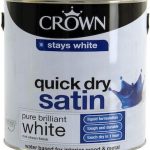
Crown Quick Dry Satin Paint

Best for: Hard-wearing wipeable woodwork in busy hallways and kids' rooms
Check Price On AmazonCrown's Quick Dry Non Drip Satin is a water-based paint made specifically for interior wood and metal. The tin in our photo is Cream White, which is handy if brilliant white looks too stark against your walls. It's touch dry in an hour and Crown says it stays white.
The finish is hard-wearing and wipeable, so it suits hallway doors, banisters and children's bedrooms where woodwork gets handled and needs regular cleaning. UK retailer listings put coverage at up to 14 square metres per litre, and the paint goes on easily by brush or roller without dripping. You'll need two coats for the best finish, which is easy to fit into a day given the quick drying time.
What we like
- Touch dry in 1 hour
- Hard-wearing and wipeable
- Non-drip and easy to brush or roll
- Stays white according to Crown
- Made for interior wood and metal
What to know
- Needs two coats for the best finish
- Coverage of up to 14 square metres per litre according to retailers
Our verdict
Crown Quick Dry Satin is a good all-round satinwood for busy areas where the woodwork gets wiped down regularly. Touch dry in an hour, it gets two coats on a hallway's doors and banisters in a day. For better coverage, Dulux Quick Dry Satinwood goes further per litre, and if you want more colours to choose from, Johnstone's Interior Wood and Metal has ten.
Best Non-Yellowing
Ronseal 2-in-1 Satinwood Paint

Best for: Bare or worn interior wood where you want to skip the primer
Check Price On AmazonRonseal's 2-in-1 primes and paints at once, so it's aimed at bare or worn interior wood where you'd otherwise need a separate primer. Ronseal says two coats are all you need, and it's the paint to look at if you're painting new pine doors or freshly fitted skirting boards.
The big selling point is the 10 year stay white guarantee, the strongest whiteness promise in this list. It's water based, low in VOCs and non-drip, and it's touch dry in 30 minutes. Coverage is the trade-off, at up to 6.5 square metres per litre, which is roughly half as much as most of the others here, so you'll need more tins on a large job. Bare knots should still be sealed first.
What we like
- 10 year stay white guarantee from Ronseal
- Primes and paints in one
- Touch dry in 30 minutes
- Water based and low in VOCs
- Non-drip brush application
What to know
- Covers only up to 6.5 square metres per litre
- Needs two coats for the best non-yellowing finish
Our verdict
Ronseal 2-in-1 is the one we'd pick for bare interior wood when you want to cut out the primer and keep the white bright for years. Buy more paint than you think. If the woodwork is already painted, Dulux Once Satinwood covers far more per litre in one coat, and for the fastest overall job on sound paint, Dulux Quick Dry is the better pick.
Best Value Runner-Up
Leyland Oil Based Satinwood Paint

Best for: Large areas of woodwork on a tight budget where smell isn't a concern
Check Price On AmazonLeyland's satinwood is the cheapest per litre in this roundup and the oil-based option here. It's self-undercoating, suits interior wood and metal, and leaves a hard-wearing, knock-resistant satin finish. Coverage is up to 20 square metres per litre, the best in this list.
Being oil based, it flows out smoothly and hides brush marks well, though it's slow, at touch dry in 4 hours and 16 to 24 hours before recoating. It comes in 2.5 or 5 litre tins and goes on by brush or roller. When we used it on skirting, the smell was strong, so keep windows open. Like other oil-based paints, its whites will go creamy over time, more so than water-based satinwoods.
What we like
- Up to 20 square metres per litre
- Cheapest per litre in this roundup
- Self-undercoating
- Hard-wearing and knock-resistant
- 2.5 or 5 litre tins
What to know
- Strong smell when we used it on skirting
- 16 to 24 hours before recoating
- Oil-based white yellows faster than water-based paints
Our verdict
Leyland suits anyone painting a lot of woodwork on a budget who doesn't mind the smell and longer drying. With up to 20 square metres per litre at the lowest price per litre here, it's the most economical way to cover a lot of woodwork. If you want whites that stay brighter, Johnstone's Interior Wood and Metal is the water-based value alternative, and for a faster job, Dulux Quick Dry dries in an hour.
Choosing A Satinwood Paint For Interior Woodwork
Most satinwoods look similar in the tin. What separates them is the base, how they handle bare wood, how much they cover and how they behave over the years.
Water-Based Versus Oil-Based Satinwood
Water-based satinwood dries in an hour or two, smells far less and washes out of brushes with water. It also stays white, which is a big reason for its popularity. The finish can show slightly more brush marks, so use a good synthetic brush and don't overwork it.
Oil-based satinwood flows out to a very smooth finish and is tough, but it takes a day to dry, smells strongly and turns cream over time, especially away from daylight. Our guide on why gloss paint goes yellow explains the same process, which affects oil-based satinwood too.
Self-Undercoating And Bare Wood
Most satinwoods here are self-undercoating, so they go straight over sound, sanded paint without a separate undercoat. Bare wood is different. Seal knots first with a knotting solution, then use a primer or a primer-and-paint product like Ronseal 2-in-1. Skipping this lets resin and tannins bleed through as brown stains.
Painting Satinwood Over Gloss
Satinwood goes over old gloss happily as long as the gloss is keyed. Wash it with sugar soap, sand it to a dull finish with fine abrasive paper and wipe off the dust. Our guide to painting satinwood over gloss walks through the steps. Water-based satinwood over oil-based gloss needs a good key or a suitable primer to grip.
Coverage And Coats
Coverage varies a lot, from about 6.5 square metres per litre for Ronseal 2-in-1 up to 20 for Leyland. Most need two coats, while Dulux Once is designed for one. Measure your woodwork roughly, check the figure on the tin and allow for two coats unless you're using a one-coat paint.
Metal And Other Uses
Most of these satinwoods suit interior metal like radiator pipes and metal door frames as well as wood. They're a good match for painting kitchen cupboards if the doors are properly primed. For the radiators themselves, a dedicated paint from our list of the best radiator paints copes better with the heat.
Satinwood Paint Questions We Hear
What is the difference between satinwood and gloss?
Satinwood has a mid sheen that's softer and less reflective than gloss, which has a high, mirror-like shine. Satinwood hides brush marks and small dents better and looks more modern on doors and skirting. Gloss is slightly tougher and suits a traditional look. Water-based satinwood also stays white for longer than traditional oil-based gloss.
Does satinwood need an undercoat?
Most modern satinwood paints are self-undercoating, so they don't need a separate undercoat over sound, previously painted woodwork. Bare wood needs knotting and a primer first, unless you use a primer-and-paint product such as Ronseal 2-in-1. A big colour change, like covering dark woodwork with white, can need an undercoat to stop the old colour showing through.
Does water-based satinwood go yellow?
Water-based satinwood stays white and doesn't yellow the way oil-based paints do, which is one of the main reasons decorators have switched to it. Oil-based satinwood and gloss gradually turn cream, especially in darker rooms. If yellowing is your main concern, choose a water-based product such as Ronseal 2-in-1, which comes with a 10 year stay white guarantee.
Can you use satinwood on walls?
You can use satinwood on walls, but it's more expensive than emulsion and its sheen highlights any bumps in the plaster. It's sometimes used in hallways and kitchens where walls need regular wiping. For most walls, a durable emulsion is the better choice, and our pick of the best emulsion paints includes tough, washable options.
Is Dulux Quick Dry Satinwood worth paying more for than Johnstone's?
Dulux Quick Dry Satinwood is worth it if coverage and speed matter. It's the dearest per litre in our roundup, but Dulux quotes up to 16 square metres per litre against 12 for Johnstone's, and it's touch dry in an hour. Johnstone's costs less and comes in ten colours. Our woodwork needed two coats of Johnstone's, and Dulux recommends two coats as well.
Does Dulux Once Satinwood really need only one coat?
Dulux designs Once Satinwood to finish in a single coat with no undercoat, as long as you lay it on thickly and evenly. That's how we applied it on skirting during our renovation, and the result was excellent. Thick paint can sag if you overload it on vertical surfaces, and it takes up to 16 hours to dry fully, so leave it overnight.
Is oil-based Leyland satinwood still worth buying?
Leyland Oil Based Satinwood is worth buying if you're painting a lot of woodwork on a budget. It's the cheapest per litre in our roundup and covers up to 20 square metres per litre, the best in the list. The trade-offs are a strong smell when we used it on skirting, 16 to 24 hours before recoating, and a white that yellows faster than water-based paints.
What would you use on new bare pine doors?
Ronseal 2-in-1 Satinwood Paint is the one to look at, because it primes and paints in one and Ronseal says two coats are all you need. It carries a 10 year stay white guarantee, the strongest whiteness promise in our list. It only covers up to 6.5 square metres per litre, so buy more paint than you think you need.
Which Satinwood Paint We'd Buy
Dulux Quick Dry Satinwood is our top satinwood for interior wood and metal, drying fast and covering well with a white that stays white. Johnstone's Interior Wood and Metal is the value alternative, and Dulux Once is the one to choose if you'd rather get the job done in a single coat.

Eddie spent five years as a self-employed painter and decorator before going part time to become one of the main writers at DIY Works. From garden fences to mist coats on fresh plaster, painting and decorating is his speciality.