How To Break Up Concrete
An SDS drill and a crowbar make short work of old hearths and paths once you know where to start.

The short answer
The easiest way to break up concrete is with an SDS drill and a chisel bit. Hold it at around 45 degrees, chip in from an edge and lever the big pieces out with a crowbar as they crack free. Damp the area down and wear eye, ear and dust protection. Without an SDS drill, a sledgehammer or a hammer and bolster chisel works on thinner concrete.
Concrete turns up everywhere on renovation jobs, from old fireplace hearths and fence post footings to garden paths, shed bases and raised sections of floor. Laying it is straightforward, as our guide to laying concrete shows, but getting it back out again takes the right tool and a bit of method.
We break up concrete regularly on our own property projects, so rather than a theory lesson, this guide follows a real job from one of our renovations.
The Best Tool For Breaking Up Concrete
You can break concrete by hand with a sledgehammer, but an SDS drill in hammer-only mode does the job far faster with much less effort. The weight and hammer action of the tool do the work, so you're guiding the chisel rather than swinging at the concrete. Our pick of the best SDS drills for breaking concrete covers the models we rate.
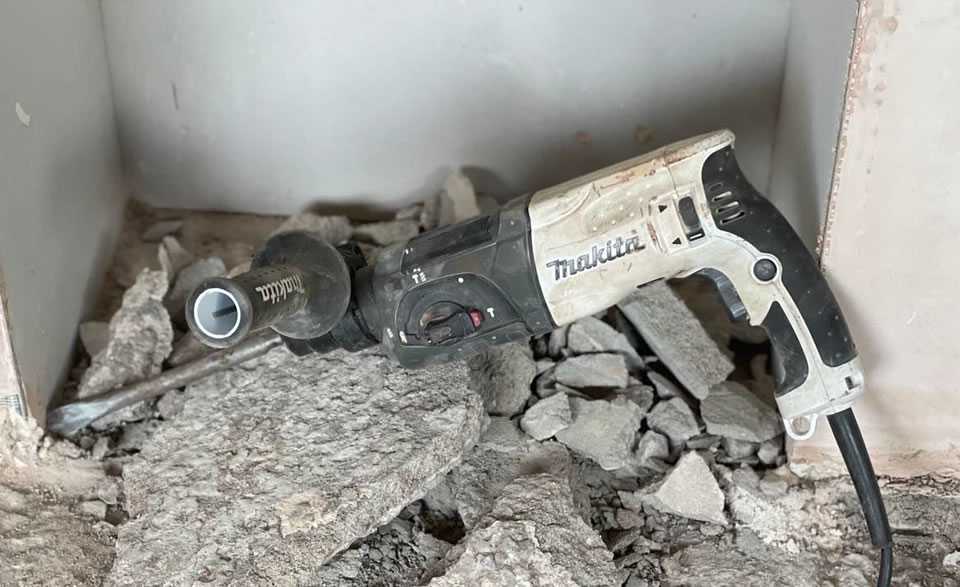
An SDS drill handles thick bases, slabs, walls and footings, and it's the tool we reach for first. If you don't own one, tool hire shops rent them by the day, which makes sense for a one-off job. For big areas such as a whole driveway or a thick garage base, hire a heavier breaker instead.
Our Job Breaking Up An Old Fireplace Hearth
On one of our renovations, we needed to level a floor after taking out an old fireplace. The concrete hearth in front of the opening sat proud of the rest of the floor, so it had to come out before anything else could go down.

We broke the hearth up with the SDS drill and cleared the rubble, then mixed fresh concrete to fill the hole that was left. Once that had dried, we laid self-levelling compound across the whole floor to give a flat base.
How To Break Up Concrete With An SDS Drill
Our preferred method is an SDS drill with a pointed or flat chisel bit, backed up by a crowbar for lifting out the larger lumps. We've used it on a number of jobs, and it's what you can see in the photo below.
What You'll Need
- SDS drill with a hammer-only setting
- Pointed or flat chisel bit
- Crowbar or wrecking bar
- Safety glasses, ear defenders, gloves and safety boots
- A dust mask rated for fine dust
- Watering can or spray bottle
- Rubble bags and a shovel
Step By Step
- Check the area for buried pipes and cables before you start, especially in floors and near walls.
- Fit the chisel bit to the SDS drill and switch it to hammer-only mode.
- Lightly dampen the concrete with water to keep the dust down, and put on your mask and other safety gear.
- Start at an edge or a crack rather than the middle, holding the chisel at around 45 degrees to the surface.
- Let the drill do the work, chipping a line into the concrete so pieces break away towards the open edge.
- Lever up larger pieces with a crowbar as they crack free, then clear the rubble so you can see the next edge.

If you hit steel mesh or reinforcing bar inside the concrete, cut through it with bolt cutters or an angle grinder with a metal cutting disc as you go, then carry on breaking around it.
If you don't have an SDS drill, the methods further down still get the concrete out. They just take more time and a lot more effort.
Staying Safe While Breaking Concrete
Breaking concrete throws out sharp chips and fine dust, and the dust contains silica, which is harmful to breathe in. Damping the surface down helps, but wear a proper dust mask as well, along with safety glasses, ear defenders, gloves and boots. Keep children and pets well away, and work with doors open indoors so the dust can clear.
Getting Rid Of Broken Concrete
How you dispose of the rubble depends on how much there is. A small job like a hearth or a fence post footing fits into a few rubble bags, which you can take to your local recycling centre, but check its rules first, as many limit the amount of rubble you can bring and some charge for it.
For a bigger area such as a path or base, a skip or a grab bag collected by a licensed waste company is far easier. Clean broken concrete can also be reused as hardcore under a new base or path, which saves both disposal and buying in fresh hardcore.
Other Ways To Break Up Concrete
Breaking Concrete By Hand
Breaking concrete by hand is harder work, but it's perfectly effective on thinner slabs, paths and small footings. Use a sledgehammer for open areas, or a lump hammer and bolster chisel for tighter spots and edges.
The approach is the same as with the SDS drill. Start at an edge, strike the concrete a short distance in from it so the piece breaks towards the open side, and lever the broken sections out with a crowbar. Digging out a little soil under the edge of a slab first gives it room to crack downwards.
Using Expanding Demolition Grout
Expanding demolition grout, also called non-explosive demolition agent, breaks concrete without any hammering. You drill a pattern of holes into the concrete with a masonry bit, mix the grout with water and pour it into the holes. As it sets it expands with great force and splits the concrete apart over the following hours.
It earns its place where noise and vibration are a problem, or on very thick concrete that a hand-held breaker struggles with. What holds it back is the cost and the handling. The grout is strongly caustic, so wear gloves and eye protection, and keep everyone away from the holes while it's working. Our guide to the best masonry drill bits for concrete covers bits that can drill the holes.
Choosing The Right Method For Your Job
For most homeowners, the SDS drill and chisel bit is the way to go, and it's the tool that got our old hearth out. Keep the sledgehammer for thin slabs and paths, and save demolition grout for jobs where you can't make a racket. If you're replacing what you've broken out, our guide on how long concrete takes to dry helps with planning the next stage.
Watch Us Do It
Need To Break Concrete? An SDS Drill Is What You Require & We've Tested Multiple To Find The Best!
Other Questions We Get Asked
What is the easiest way to break up concrete?
The easiest way to break up concrete is an SDS drill set to hammer-only mode with a chisel bit fitted. Start at an edge, hold the chisel at around 45 degrees and let the tool's weight do the work, then lever out the loose pieces with a crowbar. For very large areas, hire a heavier breaker instead of an SDS drill.
Can you break up concrete with a sledgehammer?
Yes, you can break up concrete with a sledgehammer, and it works well on thin slabs, paths and small footings. Strike a short distance in from an edge so the concrete breaks towards the open side, and dig a little soil out from underneath first to give it room to crack. Thick or reinforced concrete is far quicker with an SDS drill or breaker.
How do you break concrete without a breaker?
Without a breaker, you can break concrete with a sledgehammer, a lump hammer and bolster chisel, or expanding demolition grout. Hand tools suit thinner concrete, while demolition grout poured into drilled holes cracks thick concrete quietly over several hours. An SDS drill with a chisel bit is a cheaper and smaller alternative to a full-size breaker for most household jobs.
Is concrete dust dangerous?
Yes, concrete dust is dangerous to breathe in because it contains crystalline silica, which can damage the lungs. Keep the concrete damp while you break it, wear a dust mask rated for fine dust and ventilate indoor spaces well. Sweep up with the dust dampened down, or use a vacuum designed for construction dust, rather than dry sweeping.
Should I buy an SDS drill or hire one for a single job?
For a one-off job, hire one. A day's hire covers something like a hearth or a footing, and you're not left with a tool sitting in the shed. If you break up concrete regularly, as we do on our own property projects, owning one pays off. A whole driveway or thick garage base is heavy breaker territory either way.
What do I do if I hit steel mesh or rebar in the concrete?
Cut through it as you go with bolt cutters or an angle grinder fitted with a metal cutting disc, then keep breaking around it. Keep your glasses and gloves on for the cutting too. Clearing the rubble as it comes away shows you where the steel runs and where to start on the next edge.
What should I check before I start breaking up a concrete floor?
Check the area for buried pipes and cables, especially in floors and near walls, before you fit the chisel bit. After that, put on your safety glasses, ear defenders, gloves, boots and a dust mask, and lightly dampen the concrete to keep the dust down. Start at an edge or a crack rather than the middle.
Where can I get rid of the broken concrete?
A small job fits in a few rubble bags for the local recycling centre, though it's worth ringing ahead because many cap how much rubble they take and some charge for it. A path or base is a skip or grab bag job from a licensed waste company. Clean broken concrete also makes good hardcore under a new base, which saves paying to get rid of it.

Dave, or Demolition Dave as the team calls him, worked as a builder for over 10 years before joining DIY Works. He now concentrates on his own properties and writes most of our construction content, along with tools, carpentry and plenty more.