The Complete Guide To Tile Spacers
The width of your grout lines changes the whole look of a tiled wall or floor so it pays to choose spacers with care.

Written by David White
Updated

The short answer
Tile spacers are small plastic crosses that hold an even gap between tiles while the adhesive sets. British Standards guidance puts wall tile joints at 2 to 3 mm and floor tile joints at 3 to 5 mm, so pick spacers in that range. Push one into each corner as you lay the tiles, and take them out before the adhesive goes hard, following the timing on the adhesive bag.
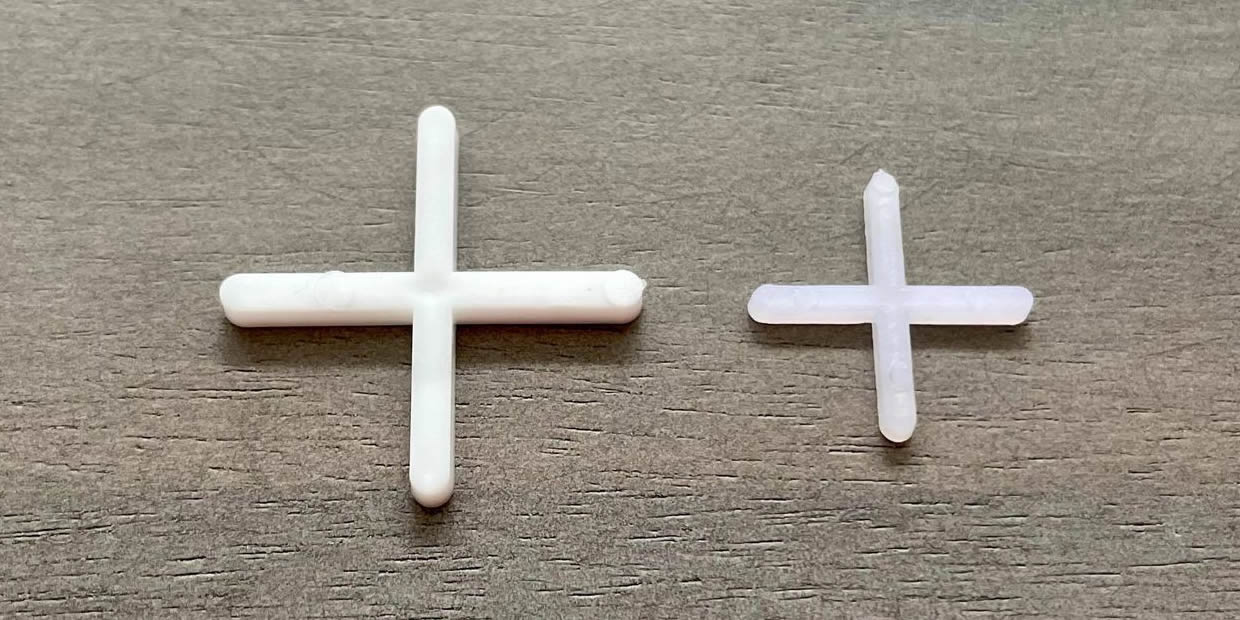
Tile spacers are the cheapest part of a tiling job and one of the easiest to overlook, yet they decide how straight and even every grout line looks once the job is done. Each one is a small plastic cross that sits between the corners of neighbouring tiles and holds them a set distance apart while the adhesive grabs.
They come in a range of sizes for walls and floors, and we treat them as one of the essential tools needed for tiling. This guide covers which size to choose, how many to buy, how to fit them and the point at which they need to come out.
What Size Tile Spacers To Use
Two things decide the size, the look you're after and whether the tiles are going on a wall or a floor. Thin joints let the tiles take centre stage, while wider joints make the grout part of the design and give a little more room for tiles that aren't perfectly uniform in size.
Then there's the cleaning. Wider grout lines on a floor hold on to more dirt, so going large means more time on your knees with a brush, and a good grout cleaner for tired tile joints helps keep them looking fresh.
British Standards guidance gives a sensible starting point, with wall tile joints of 2 to 3 mm and floor tile joints of 3 to 5 mm. Floors move more and carry more load than walls, which is why the joints are a touch wider.
How Many Tile Spacers You Need
Spacers are sold in big bags at DIY sheds and online, and they cost very little whichever size you choose. Multiply your number of tiles by four and you'll have more than enough. Each cross ends up shared at the junction of four tiles, so that figure leaves a comfortable surplus for the edges, the ones that get dropped and the ones that get stuck. Running out halfway across a wall is far more of a nuisance than having a handful left over.
How To Use Tile Spacers
Spacers go in tile by tile as you work, so have the bag open beside you before the adhesive goes on. Fit them in this order:
- Spread and comb your adhesive over a small area.
- Bed the first tile in place against your starting line or batten.
- Push a spacer into each corner, sitting it below the face of the tile so it doesn't get trapped under the grout.
- Set the next tile tight against the spacers, so the gap is held on every side.
- Stand spacers on edge along the joints if you want them easier to pull out later.
- Check the rows with a spirit level every few tiles and adjust while the adhesive is still soft.
The photo below is from a wet room we tiled, with spacers at every joint keeping the large-format tiles in even rows as the wall went up.

When To Remove Tile Spacers
Your adhesive sets the deadline. A fast-setting one can cure in as little as 30 minutes, so the spacers need to be out before then, while a standard adhesive gives you longer. The bag or tub states when spacers should be removed, and that's the figure to follow.
Spacers left too long get locked in by the adhesive, while pulling them too early lets the tiles slide out of line. Keep an eye on the clock from the moment each section goes on and work back along the wall in the order you laid it.
The tip of a chisel or the corner of a scraper flicks them out with little effort. Give them a rinse afterwards and they're ready for the next job.
Tile Spacers Or A Tile Levelling System
Spacers control the gap between tiles, but they do nothing about lipping, where one tile edge sits proud of the next. For large-format floor tiles, a tile levelling system clips under the edges and pulls neighbouring tiles flush while the adhesive sets, and many systems set the joint width at the same time. On standard wall tiles, spacers and a spirit level do the job on their own.
Choosing Spacers For A Neat Finish
Get the size right for the surface and keep more spacers to hand than you think you'll need. The part people get wrong is timing, so watch the adhesive and have them out before it sets. After that, the joints are ready to grout, and our guide on removing and replacing grout covers getting a clean finish. If you're still cutting tiles to size, read our guide on how to cut tiles neatly and our tested picks of the best tile cutters for walls and floors.
Other Questions We Get Asked
Should you leave tile spacers in when grouting?
Take tile spacers out before grouting. Spacers left in the joints reduce the depth of grout over them, which leads to cracked or patchy grout lines and can let water through in a shower. Pull them out once the adhesive has firmed up but before it sets hard, and rake out any adhesive that has squeezed into the joints.
What size tile spacers should you use for floor tiles?
Use 3 to 5 mm tile spacers for floor tiles, which is the range British Standards guidance gives for floors. Larger tiles and tiles with slightly uneven edges suit the wider end of the range. Floors carry weight and move more than walls, so a slightly wider joint gives the grout more room to cope.
Can you reuse tile spacers?
You can reuse tile spacers as long as they're removed before the adhesive sets and come out unbroken. Rinse off any adhesive while it's still soft and let them dry. Bent or snapped spacers should go in the bin, as they won't hold an even gap on the next job.
Do you need tile spacers for rectified tiles?
Rectified tiles still need tile spacers, though the precise edges mean you can use a narrower joint than with standard tiles. The spacers keep the lines straight while the adhesive sets and leave room for grout. Large rectified floor tiles pair well with a tile levelling system to stop the edges sitting at different heights.
How many tile spacers should I buy?
Four per tile is the easy sum, and it gives you plenty. Most crosses end up shared between four tiles, so you'll have a good surplus to cover the edges and the ones that end up on the floor. They cost so little that buying too many beats running out halfway along a row.
Where should the spacers sit so they don't get trapped under the grout?
Press them in below the face of the tile, so they're clear of where the grout will finish. If you'd rather not dig them out of corners later, stand them on edge in the joints instead, where there's more to grip. Either way, a chisel tip or the corner of a scraper lifts them out.
What happens if I leave tile spacers in too long?
They set solid in the adhesive and won't budge, and anything left in the joint cuts down the depth of grout over it. Go too early and the tiles slide out of line instead. With fast-setting adhesive the window can close in half an hour, so read the removal time on the bag before you start.
Do wider grout lines make a floor harder to keep clean?
Yes. More grout on show means more surface for dirt to settle into, and floors pick up far more of it than walls. That's the trade-off for the bolder look wide joints give, and the extra tolerance they allow for tiles that vary slightly in size. If you go wide, budget for a decent grout cleaner.
Dave, or Demolition Dave as the team calls him, worked as a builder for over 10 years before joining DIY Works. He now concentrates on his own properties and writes most of our construction content, along with tools, carpentry and plenty more.